“The important thing is not to stop questioning. Curiosity has its own reason for existing.” – Einstein
Students learning through their own agency and investigations. What a wonderful concept that allows for voice and choice. Inquiry is a passion of mine and I am in a constant state of wonderment of what my students can achieve.
There are a multitude of possibilities when you think about inquiry and the opportunities that can open up when you incorporate it into a classroom. An understanding environment that is based on trust and where students are valued are integral for inquiry to work.
So what is inquiry to me?
Inquiry learning essentially is a way of thinking that traverses all learning areas. It gives students choices to take risks, embrace and learn from mistakes, opportunities to excel and support to grow into their potential. It is a process that allows students to pursue their interests and develop collaborative, thinking and problem solving skills. Essentially, inquiry learning encourages students construct meaning for themselves and in doing so they engage more passionately when trying to answer questions that interest them. In the end, students’ take away both content and process, the latter develops the notion of lifelong learners.
Embarking on the inquiry pathway does require both planning and flexibility in addition to knowing the student to a depth of anticipating their interests and limits. It requires you to be innovative and creative so as to find ways to integrate necessary content. While many new to inquiry learning may feel resistance or frustration along the way, it is definitely worth the effort of persisting. It is important to remember that true learning occurs when students engage with a question or personal inquiry by discovering answers, coming up with theories and formulating more questions.
So where to begin?
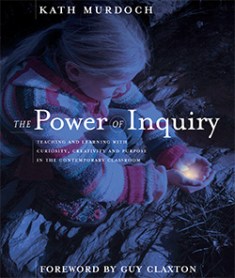
I do not believe there is a one size fits all, just as our students are not all the same. That is why I think it is invaluable to read as much on the topic as possible and formulate protocols/scaffolds for your classroom that suits both you and your cohort of students. There are two books that I highly recommend reading to gain a better understanding of inquiry learning and to get you started: Dive into Inquiry by Trevor MacKenzie and The Power of Inquiry by Kath Murdoch. Both books are affirming and challenging my thinking about inquiry, acknowledging it has many guises. I am buzzing with possibilities.
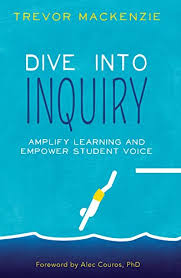
Dive into Inquiry by Trevor MacKenzie
The door of inquiry opened to Trevor when he asked one of this students “What do you truly love to do?” This question inadvertently transformed a struggling student’s life as well as the way Trevor managed his classroom. His book gives you many examples of students’ successes through using the Inquiry approach. I love the fact that many are extended with QR coded links. He writes about how taking responsibility for learning empowers students and amplifies learning.
This particularly resonated with me. This is exactly what is needed to avoid the all too often ‘learned helplessness’ that we see surfacing more and more in a world where are students have become the ‘I want it now’ generation. Everything is at their fingertips. There is no need to persist and information is readily available. Patience is a virtue but many students seem to lack the effort required. Inquiry learning changes this perspective. It is through exploring the learning process that headways are made.
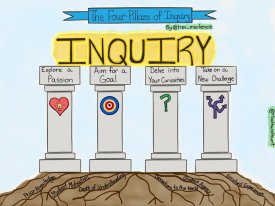
Being a visual learner myself, I particularly loved the graphics he used to highlight key learning in the process of scaffolding inquiry. As the saying goes, “a picture says a thousand words.” The following two graphics have defiantly caused me to pause for thought. Have I been structuring inquiry following a progression of stages? Do I offer four options for beginning inquiry questions as suggested in the Four Pillars of Inquiry? Having only just read this book, I am eager to reflect on these questions and make classroom adjustments accordingly. I am very excited!

The Power of Inquiry by Kath Murdoch
Kath’s book is a hands on resource that unpacks how inquiry teachers teach. It is steeped in research but is rooted in strong pedagogical foundations. It was released earlier this year and my copy is already well worn and lovingly tattered. Evidence that it was written for the busy teacher to easily access. This is a must have resource!
The Power of Inquiry is the ‘go to book’ for inquiry as it outlines the practicalities that need consideration: conducive physical space; planning; assessment; documenting what Kath refers to as i-Time; and building a school culture of inquiry. Each section offers ideas and suggestions that can be easily implemented by refinement existing teaching practices. It has lead me on a journey to reflect on the following key words: time; space; purpose; listening; observing; reflecting; and feedback. All of which remind me that it is imperative to design learning that matters.
Key points to remember:
- Collaboration allows students to delve into their questions in a fun, non-threatening way that allows them to connect and bounce ideas off one another. Collaboration is key and is fundamental to solving real life problems.
- Powerful questions help students own the process of learning. We need to help our students start asking the right questions. Not questions about learning but questions for
- Visual thinking routines or protocols foster student inquiry.
 Passionate-Teacher