Build Trust. Fail Forward.

Recently I read Open: how we’ll work, live and learn in the future by David Price, a worthwhile and recommended read. One quote stood out. One that is both worrying and a concern for many in the profession. David writes that “it is often said that a time-traveller from the 19ths century, beamed into today’s world, would be bewildered by everything he witnessed, but would instantly feel comfortable in a school.”

We have all heard much discussion about moving forward with education: blended learning, compacting curriculum, hackathons, flipped classroom, MOOCs. While the list goes on and there are many eager to explore these approaches, I believe that there are two things interfering with our progress: lack of trust and fear of failure.

Failure and making mistakes are great learning opportunities and should be viewed as the lifeblood to success. Experimentation is about moving into unknown territory and we must have the freedom to fail in order to innovate.

Perhaps we need to look not at having the freedom to fail, but view it as failing forward. If we fail forward, we learn, innovate and build resilience. Freedom comes through opportunities. Opportunities are our guides and failures are our teachers.

Henry Ford said that “failure is simply the opportunity to begin again, this time more intelligently.” It is agreed that we learn from mistakes and if we ask our students to be risk takers, then we must also be willing to take them. But why then aren’t we willing to try? Do we not take risks because we fear what others will think? Are we not capable, smart enough or experienced enough to succeed? Or is it because we feel there is no trusted support around us to help when we do make mistakes?

Michael Dell from Dell Inc stated that “to encourage people to innovate more, you have to make it safe for them to fail.”

Building mutual trust with those we work with is essential. Placing trust in others not only instils confidence but allows them to take ownership of the process. In turn, they should trust those who have given them the latitude to take risks. Trust is reciprocal. It is through this trust that we will be able to fail forward.

If our main concern is never to make a mistake, we will only ever meet the status quo. We won’t be looking for ways to make improvements or take any risks. Imagine an environment where innovation is not encouraged – All you will have is a hive full of worker bees, but no real visionaries to move forward. Is this perhaps why the time-traveller would feel at home in our classrooms?

Having the freedom to take chances and learn from our mistakes is essential. We have been doing it since childhood but somehow we have lost our courage to do it along the way. We must be able to make mistakes followed by the opportunities to grow from them and move forward in turn. It is not about rewarding the mistakes; the power lies in the trust to make them and learn.

Passion and purpose come from trust and enables us to embrace new thinking and learning. It is the courage we have in being vulnerable that supports the learning necessary for innovation, breakthroughs and success. Innovation and trust thrive in an environment where shame and blame have no stronghold. A culture that supports failing forward and encourages ownership of mistakes, reaps the benefits of better solutions and increases engagement.

Yet teaching remains one of the most private professions. We are living in a world that is highly social, linked and networked, yet we as teachers are fearful of sharing, being open to take risks and instead remain as we always have: retaining the status quo.

John Dewey said it best: “If we teach today’s students as we taught yesterday’s, we rob them of tomorrow.” We cannot continue to deprive our students. We have to work at changing the way we do things. We have to learn to trust and to have the courage to fail.

Trust doesn’t just happen, and we don’t intentionally work at building it. Perhaps this is where we start. If we want to inspire the youth of tomorrow, we must first start trusting each other, have the freedom to innovate and be willing to fail forward.

David Price claims that “hard fun is something that all learning professionals should strive to create.”  So, here’s to the hard fun ahead of us as we embrace change, begin to build trust and take greater risks to innovate.

After all, in the words of Soichiro Honda, “success is 99% failure. What we learn through failure becomes a precious part of us, strengthening us in everything we do. So, let the tough things make you tougher.”

Build Trust. Fail Forward.

Open

Fall Down Seven Times, Stand Up Eight

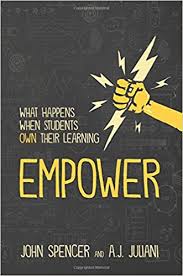
Empower by John Spencer and A.J. Juliani was a book I literally couldn’t put down and could have tweeted all of it. It was not a heavy read but it offered me questions about my teaching that was a springboard for many of my own. It has left me feeling inspired and energised at a time when I felt I was beginning to stumble.

For over a year, I have been trying to transform my teaching and my classroom. My aim was to engage my students so they could become confident self-regulated learners. I was taking a risk. I was embarking on a new realm of education. It was a direction I knew I needed to guide my students to take. I wanted them to have a voice, be creative and own their learning while they embraced the road bumps on the way. Was this feeling of stumbling based on my fears it was too left field? I mean, what if I was seen as being a neglectful teacher because I was not micromanaging every aspect of their learning?

All my previous hesitations re-emerged when reading, but this time it was with a renewed perspective, an inspired one. I was encouraged that what I was doing was definitely on the right path. I was reinvigorated that others were also on this journey – I was not alone. Perhaps I was jumping in too deep and trying too much at once. Perhaps my fear of failing was starting to hold myself and my students back. Either way, I found myself eager to try again and forge forward on my journey to empower students.

The Japanese proverb “Fall down seven times, stand up eight” comes to mind and has me wondering. Falling and getting back up is a natural process. We did this all the time growing up: when we learned to talk, walk, eat and play. At some point however, we seem to have grown out of this. Fear seems to have taken over and we have learnt to make excuses to avoid stepping too far outside the box. Perhaps we thought we were too small to make a difference. My response to this: Have you ever tried sleeping in a room with a mosquito? A small change can make a big difference and as John and A.J. suggest, “try it for just one day.” Yes, we need to step out of our comfort zone and start with one small change. After all, as Walt Disney once said, “If you can dream it, you can do it!” We should not let anything hold us back.

Whatever this change is, embrace it despite the obstacles or falls along the way. We must fall down seven times, stand up eight” to achieve our goals. We must overcome the fear of failing and celebrate every hurdle encountered. We must learn to listen to our intuition and follow our ‘flow’ – Most importantly, we must allow our students to do this also.

Life is about learning lessons, not repeating same mistakes. Mistakes are not failures but failings we can grow from. If you fall and don’t get back up, the only path left is defeat. Failure. However, if you get back up there is still hope. Failing is therefore a springboard forward. The fight to succeed is important. It is about adjusting what you are doing to achieve the desired goal. To do this, you must be creative in your thinking, open to many possibilities, and essentially have an entrepreneurial mindset. Thomas Edison daringly revealed “I never once failed at making a light bulb. I just found 99 ways not to make one.” Imagine is he didn’t ‘stand back up’ that last time?

“Fall down seven times, stand up eight” is an experience we want to inspire in our students. The students we teach will in fact create the jobs we cannot yet conceive. They are going to need to be creative, persistent in the face of setbacks and self-managers not only their time but also their goals. Should we not then be guiding our students in this process as early as possible? Only then will they have the resilience to face these challenges with confidence.

So, what is holding us back?

Whether it is our pride, our experience or current attitude, we need to be brave and ask our students to be brave too.

IMG_9742 (2)

Empower has inspired me to listen to my heart and continue my journey to transform the lives of my students. Will I succeed? Hopefully. Will I fall along the way? Absolutely. The important thing is for me to embrace the times I am failing so that when I stand back up I am prepared to take another step towards achieving my goals. With any luck, my students will experience the same. Bruce Lee once summed up the role of a teacher, one that John and A.J. present in their book, and it’s a nice quote to bring my reflection to a close:

“A teacher is never the giver of truth. He is a guide, a pointer to the truth that each student much find himself.”

Empower book

Inquiring minds want to know

“The important thing is not to stop questioning. Curiosity has its own reason for existing.” – Einstein

Students learning through their own agency and investigations. What a wonderful concept that allows for voice and choice. Inquiry is a passion of mine and I am in a constant state of wonderment of what my students can achieve.

There are a multitude of possibilities when you think about inquiry and the opportunities that can open up when you incorporate it into a classroom. An understanding environment that is based on trust and where students are valued are integral for inquiry to work.

So what is inquiry to me?

Inquiry learning essentially is a way of thinking that traverses all learning areas. It gives students choices to take risks, embrace and learn from mistakes, opportunities to excel and support to grow into their potential. It is a process that allows students to pursue their interests and develop collaborative, thinking and problem solving skills. Essentially, inquiry learning encourages students construct meaning for themselves and in doing so they engage more passionately when trying to answer questions that interest them. In the end, students’ take away both content and process, the latter develops the notion of lifelong learners.

Embarking on the inquiry pathway does require both planning and flexibility in addition to knowing the student to a depth of anticipating their interests and limits. It requires you to be innovative and creative so as to find ways to integrate necessary content. While many new to inquiry learning may feel resistance or frustration along the way, it is definitely worth the effort of persisting. It is important to remember that true learning occurs when students engage with a question or personal inquiry by discovering answers, coming up with theories and formulating more questions.

So where to begin?

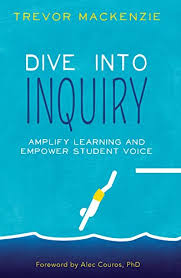
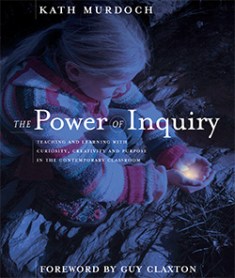
I do not believe there is a one size fits all, just as our students are not all the same. That is why I think it is invaluable to read as much on the topic as possible and formulate protocols/scaffolds for your classroom that suits both you and your cohort of students. There are two books that I highly recommend reading to gain a better understanding of inquiry learning and to get you started: Dive into Inquiry by Trevor MacKenzie and The Power of Inquiry by Kath Murdoch. Both books are affirming and challenging my thinking about inquiry, acknowledging it has many guises. I am buzzing with possibilities.

dive-into-inquiry            power-of-enquiry

Dive into Inquiry by Trevor MacKenzie

The door of inquiry opened to Trevor when he asked one of this students “What do you truly love to do?” This question inadvertently transformed a struggling student’s life as well as the way Trevor managed his classroom. His book gives you many examples of students’ successes through using the Inquiry approach. I love the fact that many are extended with QR coded links. He writes about how taking responsibility for learning empowers students and amplifies learning.

This particularly resonated with me. This is exactly what is needed to avoid the all too often ‘learned helplessness’ that we see surfacing more and more in a world where are students have become the ‘I want it now’ generation. Everything is at their fingertips. There is no need to persist and information is readily available. Patience is a virtue but many students seem to lack the effort required. Inquiry learning changes this perspective. It is through exploring the learning process that headways are made.

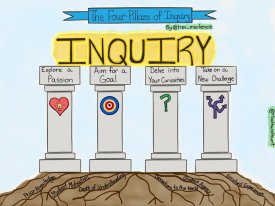
Being a visual learner myself, I particularly loved the graphics he used to highlight key learning in the process of scaffolding inquiry. As the saying goes, “a picture says a thousand words.” The following two graphics have defiantly caused me to pause for thought. Have I been structuring inquiry following a progression of stages? Do I offer four options for beginning inquiry questions as suggested in the Four Pillars of Inquiry? Having only just read this book, I am eager to reflect on these questions and make classroom adjustments accordingly. I am very excited!

types-of-student-inquiry            4-pillars-of-inquiry

The Power of Inquiry by Kath Murdoch

Kath’s book is a hands on resource that unpacks how inquiry teachers teach. It is steeped in research but is rooted in strong pedagogical foundations. It was released earlier this year and my copy is already well worn and lovingly tattered. Evidence that it was written for the busy teacher to easily access. This is a must have resource!

The Power of Inquiry is the ‘go to book’ for inquiry as it outlines the practicalities that need consideration: conducive physical space; planning; assessment; documenting what Kath refers to as i-Time; and building a school culture of inquiry. Each section offers ideas and suggestions that can be easily implemented by refinement existing teaching practices.  It has lead me on a journey to reflect on the following key words: time; space; purpose; listening; observing; reflecting; and feedback. All of which remind me that it is imperative to design learning that matters.

Key points to remember:

  • Collaboration allows students to delve into their questions in a fun, non-threatening way that allows them to connect and bounce ideas off one another. Collaboration is key and is fundamental to solving real life problems.
  • Powerful questions help students own the process of learning. We need to help our students start asking the right questions. Not questions about learning but questions for
  • Visual thinking routines or protocols foster student inquiry.